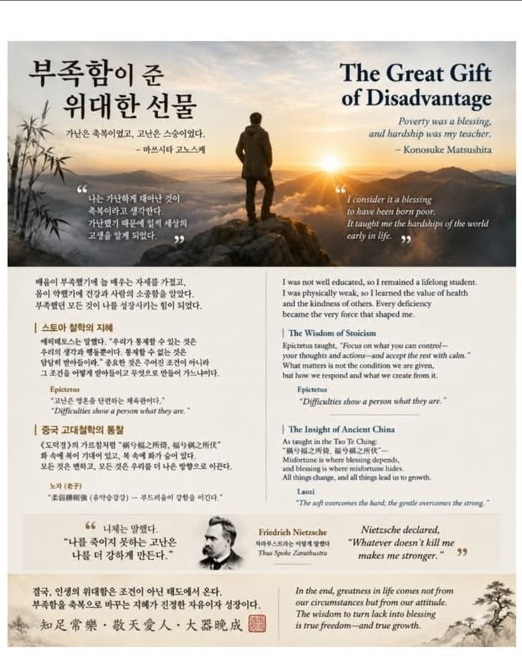
Konosuke Matsushita — the founder of what became Panasonic — often looked back on his own beginnings and described them not as a disadvantage he overcame, but as a set of teachers he happened to be given early. He was poor, and so he learned the value of hard work and the importance of people long before most of his peers. His formal education was limited, and so he remained, by necessity and then by habit, a lifelong learner. He was physically frail, and so he learned early to value health and to notice the quiet kindness of others.
An old idea, echoed across traditions
This is not a uniquely modern insight. Epictetus located freedom in judgments and actions, the only things ever truly within our control, and counseled calm acceptance of everything else. Laozi, in the Tao Te Ching, observed that misfortune is often where fortune quietly rests, and that fortune can just as easily conceal misfortune within it. Hardship and blessing, in this view, are rarely pure opposites. More often, one becomes the seed of the other.
Nietzsche put a sharper edge on the same idea: what does not kill me makes me stronger.
What we transform, not what we possess
In the end, the value of a life is not measured by how much a person accumulates, but by what that person is able to transform from whatever they were given. When we are young, we tend to believe that success simply means having more. It is usually only later that we come to understand something quieter and more durable: the very things we once lacked may have been our most effective teachers.
True freedom, by this account, is not the freedom to choose our circumstances — very few of us are granted that luxury. It is the strength to transform whatever circumstances we are given into meaning. Poverty, failure, and limitation can each become genuine assets, but only when they are met with the right attitude.
大器晩成 — a great vessel is not made overnight. Greatness, of any kind worth having, takes time.
Our lives, in the end, are not defined by the conditions we happen to receive. They are defined by the attitude with which we transform them. Our circumstances do not define us. What we make of them does.