Most of us spend the greater share of our lives making a living — working, striving, absorbing setbacks, and carrying the quiet weight of ordinary days. It is easy, in the middle of that effort, to assume that happiness is simply a function of what happens to us: the deal that closes, the recognition that arrives, the difficulty that finally passes. But the deeper truth, one that philosophers across very different traditions arrived at independently, is that happiness depends far less on the event itself than on how we choose to receive it.
What we can and cannot govern
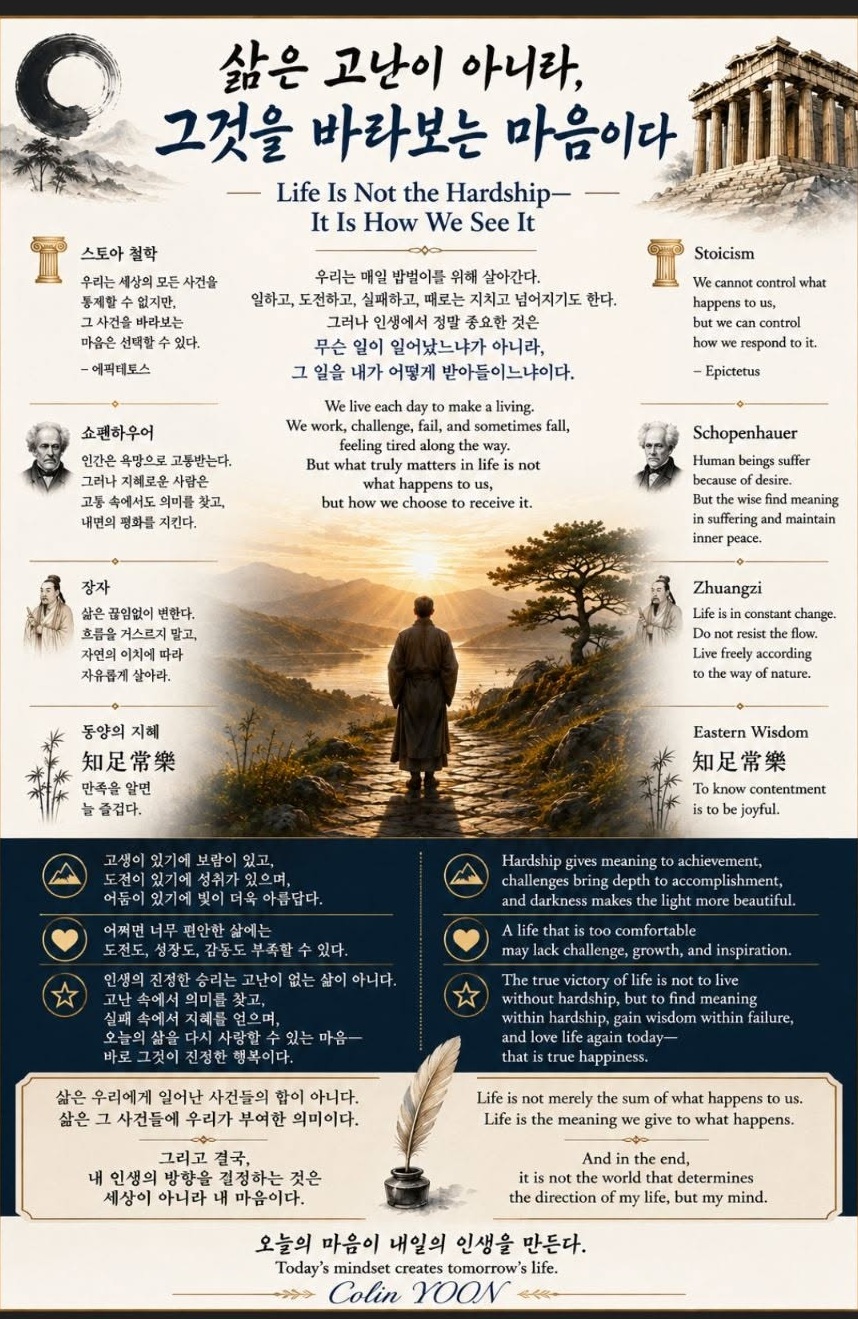
The Stoic philosopher Epictetus built his entire teaching around a single, disarmingly simple distinction: some things are within our power, and most things are not. We cannot govern every event that befalls us. We can govern our judgment of it, and our response to it. It is not, he reminds us, the event itself that disturbs us — it is the meaning we assign to it.
Schopenhauer looked unflinchingly into the nature of human desire and suffering, and found that the wise do not escape hardship so much as learn to locate meaning inside it. Zhuangzi, writing centuries earlier from a very different tradition, discovered freedom not in resisting change but in moving with it — accepting the natural flow of life rather than straining against its current.
The wisdom of enough
Eastern philosophy distills this into four characters: 知足常樂 — to know contentment is to be joyful. Not the absence of ambition, but the presence of gratitude alongside it.
Perhaps hardship is precisely what gives achievement its meaning. Perhaps challenge is what gives accomplishment its depth. And perhaps it is only against darkness that we can fully recognize the value of light. A life without any struggle may appear comfortable from the outside, but comfort alone rarely produces growth, discovery, or the particular satisfaction that comes from having earned something.
The true victory in life is not to escape hardship. It is to find meaning within hardship, wisdom within failure, gratitude within the ordinary, and joy within the journey.
The meaning we give to what happens
Life is not merely the sum of what happens to us. Life is the meaning we give to what happens. And in the end, the direction of a life is determined not by the world surrounding it, but by the mind that chooses how to face that world.
Today’s mindset creates tomorrow’s life.