Life is not a straight line. It moves like the seasons, flows like water, changes like the wind, and returns again and again to its natural rhythm.
When we are young, we often believe that life must be conquered. We pursue success, wealth, recognition, and position. We try to control circumstances and bend the world toward our desires. But time teaches a quieter truth: wisdom is not simply knowing how to gain more. It is knowing what to hold, what to release, and when to change.
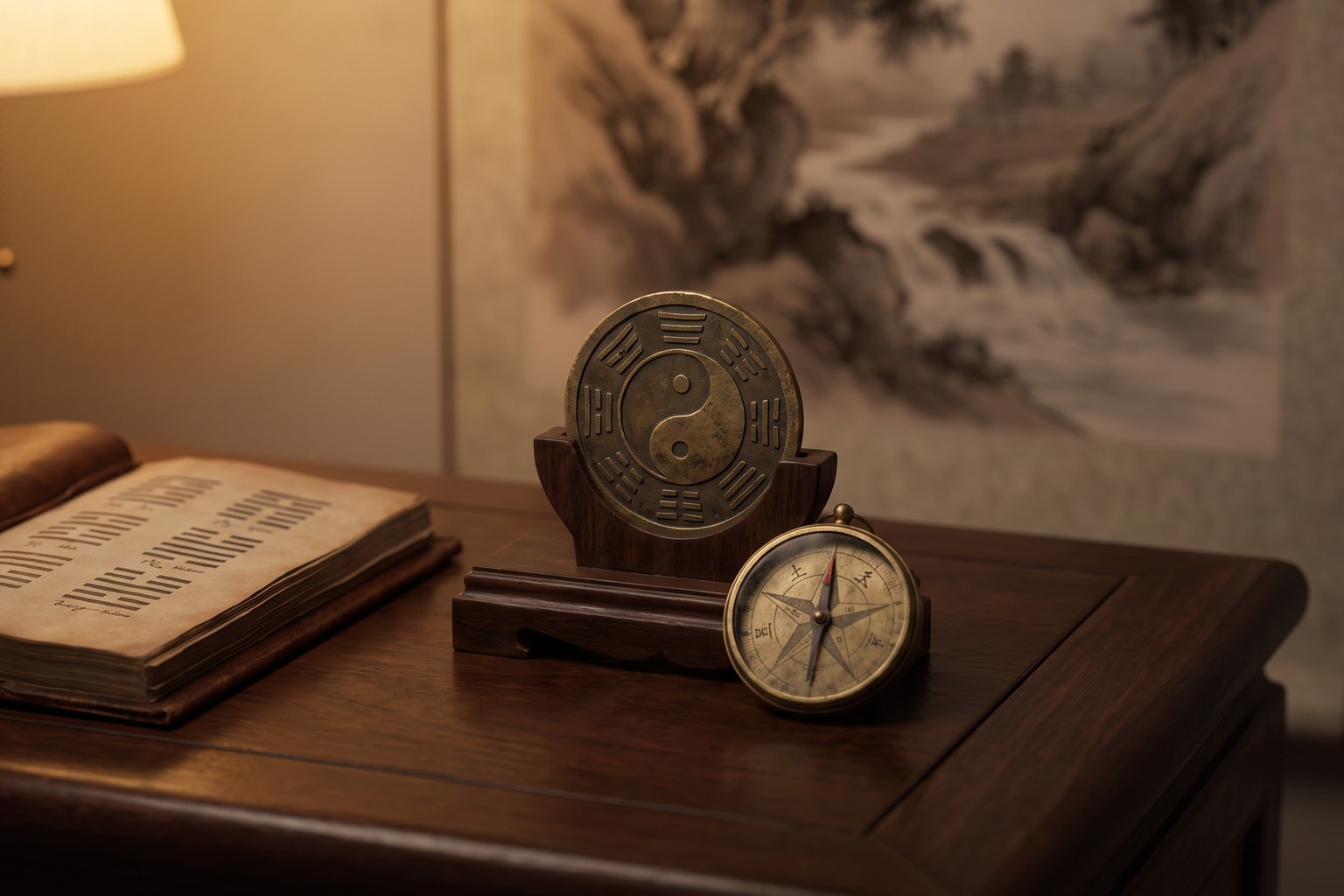
The ancient Chinese vision of Yin and Yang (陰陽) offers a profound metaphor for this truth. Yin and Yang are opposites, yet neither exists independently of the other. Light needs darkness. Movement needs stillness. Summer leads eventually to winter. Beginning contains the seed of ending.
陰中有陽, 陽中有陰 — within Yin there is Yang; within Yang there is Yin.
So it is with human life. Failure may contain the beginning of wisdom. Success may contain the seeds of decline. Youth already carries the possibility of old age, while old age can carry the deepest fruits of wisdom. Life is not about eliminating one side. It is about finding harmony between the two.
The Five Elements — The Rhythm of Becoming
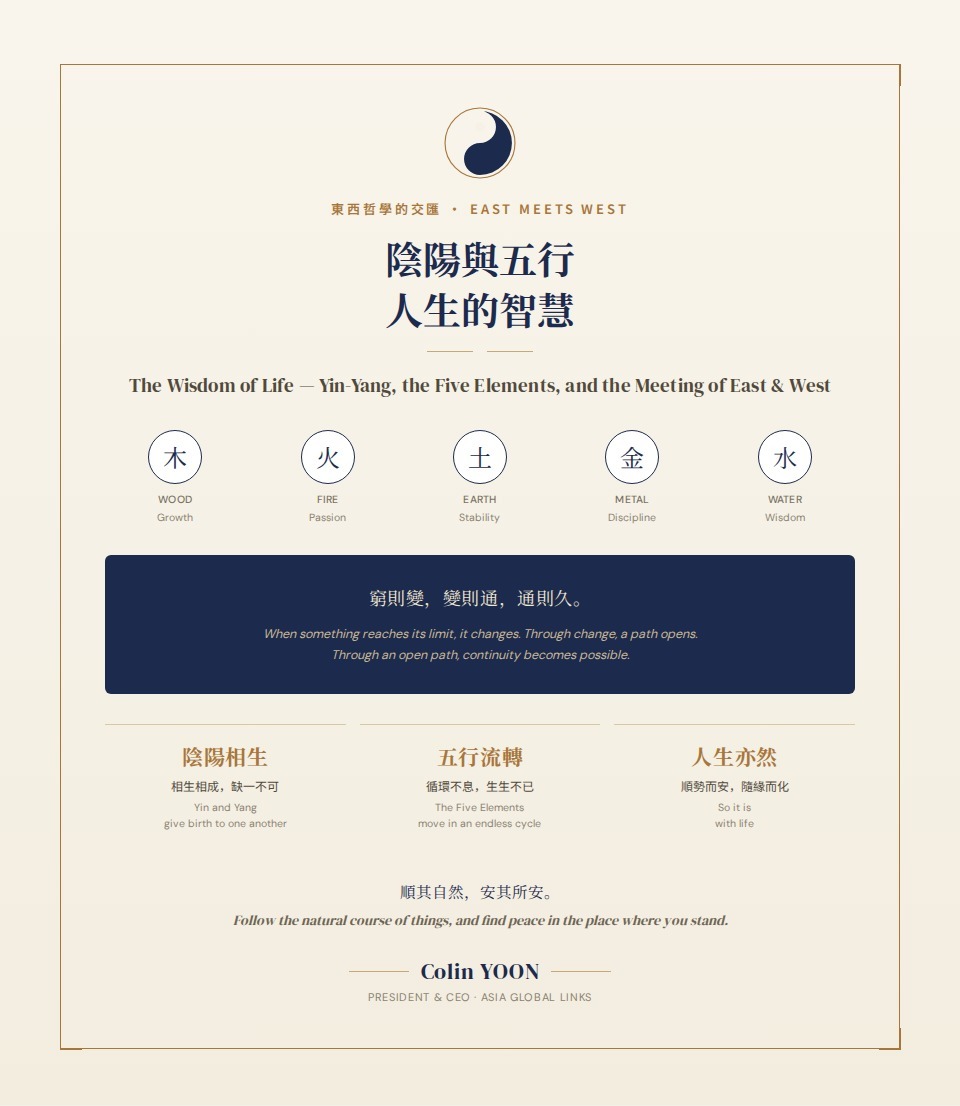
The Five Elements — Wood, Fire, Earth, Metal, and Water — can be understood as symbolic patterns of transformation rather than merely physical substances. Wood represents growth. Fire represents passion. Earth represents stability. Metal represents discipline and discernment. Water represents wisdom, adaptability, and depth.
Youth often belongs to Wood and Fire. We want to grow. We want to achieve. We want to build our place in the world. But as life matures, Earth, Metal, and Water become increasingly important. We begin asking different questions. Not simply, “What more can I acquire?” but, “What is truly worth keeping?” Not, “How much more can I say?” but, “What is worth remaining silent about?” Not, “What else must I possess?” but, “What am I finally ready to release?” That is the beginning of maturity.
Confucius — Cultivating the Self
Confucius placed great emphasis on self-cultivation. Before attempting to correct the world, one must first examine oneself. The mature person gradually moves from judging others to understanding oneself. In youth, we often ask what the world owes us. With maturity, we begin to ask, “What can I contribute to the world?” The deepest form of success is therefore not domination over others. It is mastery of oneself.
Laozi — Become Like Water
Laozi’s famous insight, 上善若水 — “The highest goodness is like water” — carries extraordinary relevance to the later stages of life. Water does not fight. It flows toward the low places. Yet over time, water can shape stone, carve valleys, and transform landscapes.
True strength does not always appear as force. Sometimes it appears as flexibility. Sometimes wisdom means knowing when to advance. Sometimes it means knowing when to step aside. The mature person does not attempt to control everything. He learns to distinguish between what must be acted upon and what must simply be allowed to unfold.
Zhuangzi — Freedom Within Change
Zhuangzi reminds us that everything is in transformation. Success and failure, gain and loss, beginning and ending are not permanent categories. What appears to be an ending may become a beginning. What appears to be failure may become wisdom. Life is therefore not a finished portrait. It is an unfinished transformation. We are not meant to remain the same person throughout our entire lives. Growth requires change.
The Book of Changes — The Wisdom of Transformation
The I Ching (周易), the Book of Changes, places transformation at the center of existence.
窮則變, 變則通, 通則久 — when something reaches its limit, it changes. Through change, a path opens. Through an open path, continuity becomes possible.
The greatest danger in life is not failure. It is refusing to change when change has become necessary. The seasons change. Circumstances change. Relationships change. We change. Wisdom does not mean resisting every change. It means changing without losing one’s center.
Thales — From Myth to the Question of Nature
In ancient Greece, Thales of Miletus asked a fundamental question: what is the underlying principle — the ἀρχή, archē — of reality? He proposed water as the fundamental principle of nature. His answer is not accepted today as a scientific description of the universe. Yet historically, his importance lies partly in his attempt to understand nature through reason and inquiry rather than relying solely on mythological explanations.
Here we find an intriguing meeting point between East and West. Chinese thought explored nature through Yin, Yang, transformation, and cycles. Thales sought an underlying principle of the natural world. Different languages. Different civilizations. Yet a remarkably similar human question: what is the nature of reality, and how does it change?
Stoicism — Control What Belongs to You
The Stoics brought the question inward. Epictetus emphasized the distinction between what lies within our control and what does not. We cannot control another person’s opinion. We cannot reverse the past. We cannot command every event in the world. But we can work on our judgment, attitude, and actions.
This is remarkably close to the wisdom of Yin and Yang. We cannot stop the wind. But we can adjust the sails. We cannot command the waves. But we can learn how to keep our balance. The wise person does not demand that the world become exactly as he wishes. He learns how to remain steady while the world changes.
The Meeting of East and West
Confucius teaches self-cultivation. Laozi teaches naturalness and non-forcing. Zhuangzi teaches freedom through transformation. The I Ching teaches change. Thales teaches the importance of rational inquiry into nature. Stoicism teaches inner discipline and serenity. And Yin-Yang and the Five Elements provide a symbolic language for bringing these insights together: balance, transformation, rhythm, harmony.
Life is never only light. Nor is it only darkness. It is never only success. Nor is it only failure. Gain and loss, meeting and separation, beginning and ending are woven together into the great fabric of existence.
The Second Half of Life — From More to Deeper
The first half of life often asks, “What can I achieve?” The second half can ask a deeper question: “What can I leave behind?” Not simply how much wealth we accumulated, but how much wisdom we cultivated. Not how many people knew our name, but how many relationships were genuine. Not how high we climbed, but how deeply we learned to see.
This is not withdrawal from life. It is a transformation of the meaning of life. We become less interested in possessing everything and more interested in understanding what truly matters. We learn to release unnecessary resentment, excessive pride, outdated ambitions, and relationships that no longer belong to our path. The lighter the burden, the deeper the soul can travel.
Conclusion — Flow Like Water, Stand Like a Mountain
Yin and Yang teach balance. The Five Elements teach transformation. Confucius teaches self-cultivation. Laozi teaches the wisdom of water. Zhuangzi teaches freedom within change. The I Ching teaches adaptation. Thales teaches the search for nature’s underlying principle. Stoicism teaches mastery of one’s response. All these traditions, despite their differences, converge upon a profound human insight:
Do not spend your life trying to control the entire world. Learn instead to find your center within a changing world.
Be flexible like water, passionate like fire, grounded like earth, disciplined like metal, and continually growing like a tree. And when the final season of life arrives, perhaps the most important question will not be, “How much did I possess?” but, “How deeply did I live?”
陰陽相生, 五行流轉, 人生亦然 — Yin and Yang give birth to one another; the Five Elements move in an endless cycle. So it is with life.
We are born. We grow. We love. We lose. We learn. We change. And eventually, we return to nature. The wisdom of life is therefore not to defeat change, but to flow with change without losing oneself. Happiness is not possessing everything. It is finding harmony with what life has placed before us.
順其自然, 安其所安 — follow the natural course of things, and find peace in the place where you stand. Then, before becoming the master of the world, we become something far more important: the master of our own life.